
What Canadian SMBs Should Know
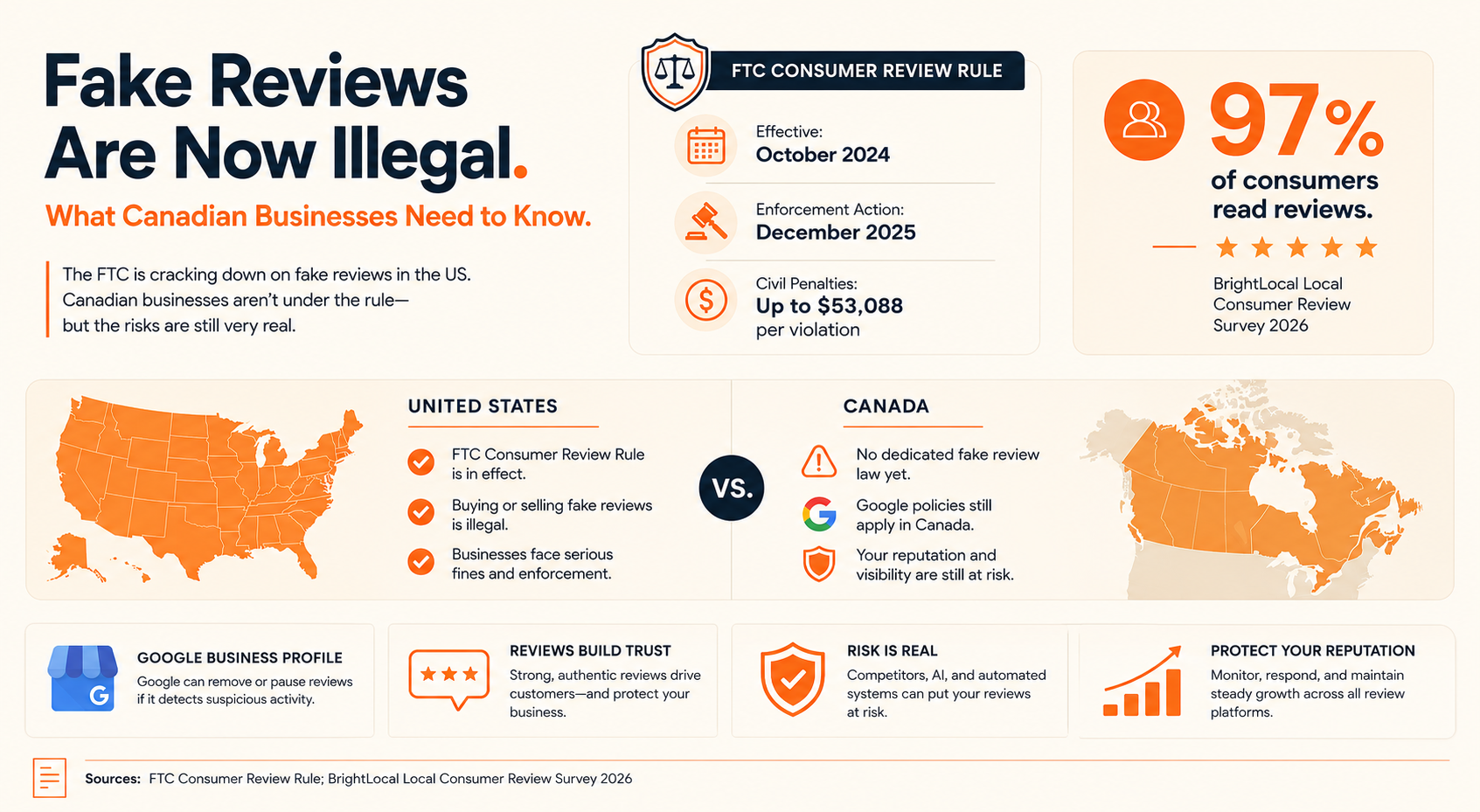
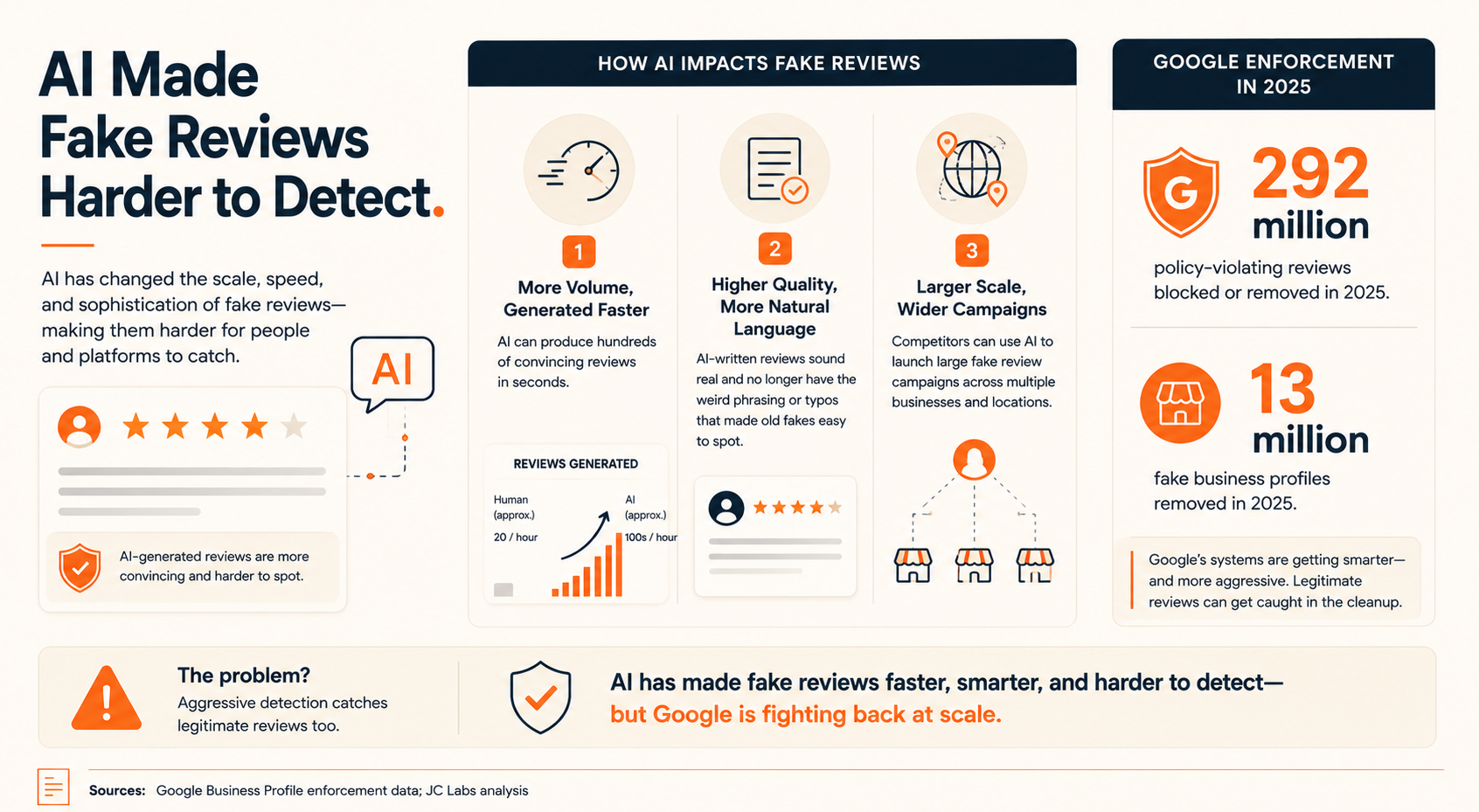
The FTC made fake reviews illegal in the US. On December 22, 2025, it sent warning letters to 10 companies for violating the new Consumer Review Rule. Civil penalties run up to $53,088 per violation.
That rule does not apply in Canada. But that does not mean Canadian businesses are safe.
Here is why you should care, what the BrightLocal 2026 survey data tells us about consumer expectations, and what Google is doing about fake reviews right now.
What the FTC Rule Actually Does (Context Only)
The FTC Consumer Review Rule went into effect in October 2024. It bans buying or selling fake reviews, using insider reviews without disclosure, misrepresenting that a review came from an actual customer, and intimidating people into removing negative reviews.
The first enforcement letters went out in December 2025. Google confirmed on July 3, 2026 that it is investigating reports of Business Profile reviews disappearing. Some businesses lost hundreds or thousands of reviews.
This rule applies to US businesses only. If you operate in Canada, the FTC cannot fine you. But as you will see, the risks are still very real.
BrightLocal 2026: What Consumers Actually Expect
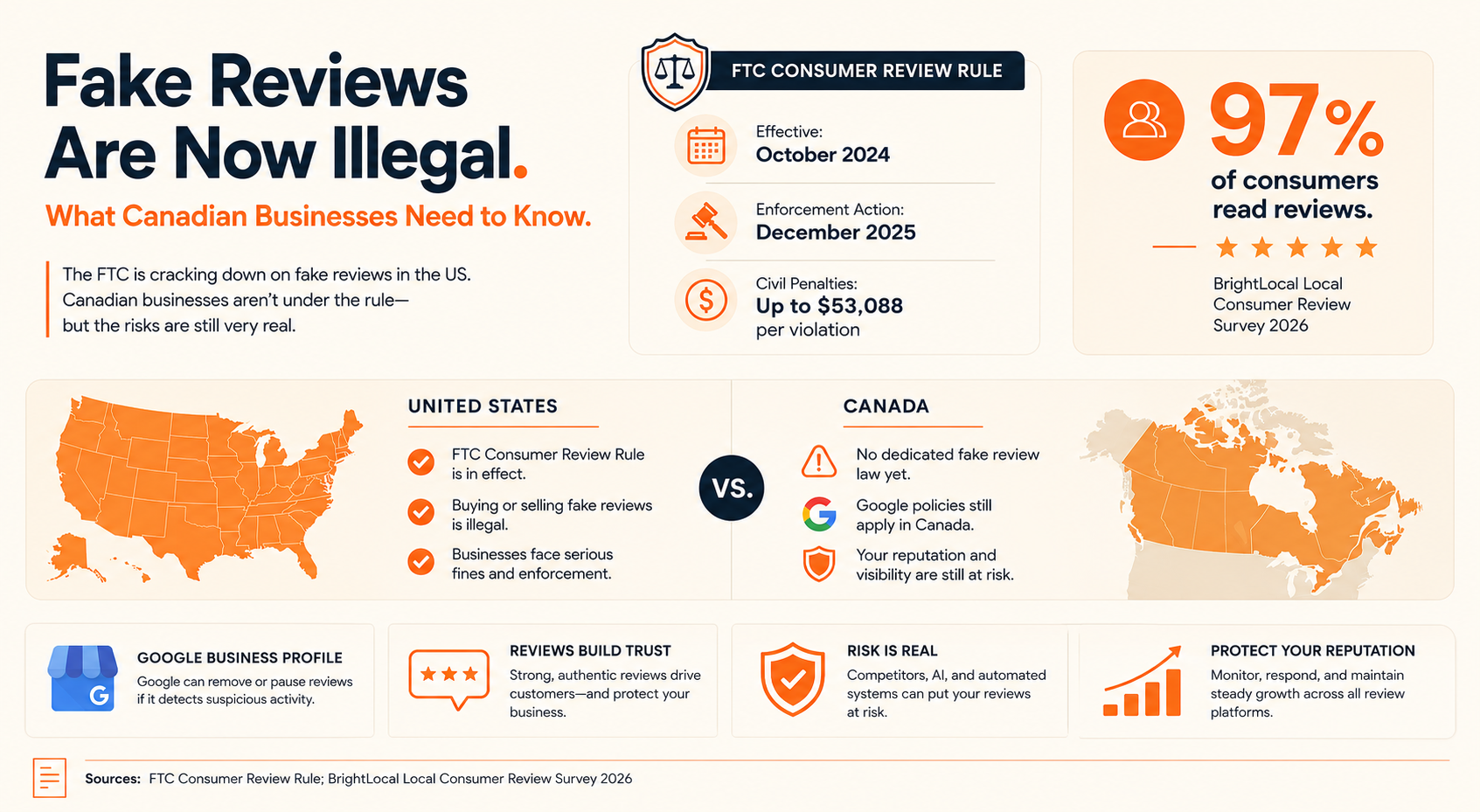
BrightLocal published its Local Consumer Review Survey in February 2026. Here are the numbers that matter for any Canadian business with a Google Business Profile.
- 97% of consumers read reviews. Not most. Nearly all.
- 41% always read reviews before choosing a business. That is up from 29% in 2025. One year, 12 points.
- The average consumer uses six review platforms. Your reputation is not just on Google. It is everywhere.
- Star ratings are climbing fast. 31% of consumers will only use businesses rated 4.5 stars or higher. That was 17% in 2025. 68% require at least 4 stars.
- 47% won't use a business with fewer than 20 reviews. Volume matters.
- Recency is critical. 74% of consumers only care about reviews written in the last 3 months. 32% look specifically for reviews from the last 2 weeks.
- Response expectations are brutal. 89% expect owners to respond. 19% expect a same-day response — triple the 6% who said so in 2025. And 50% are turned off by generic, templated replies.
A 2026 Searchlab report found that 76% of consumers are concerned about fake reviews. Most people know they exist. They want platforms and businesses to do something about it.
How AI Makes the Problem Worse
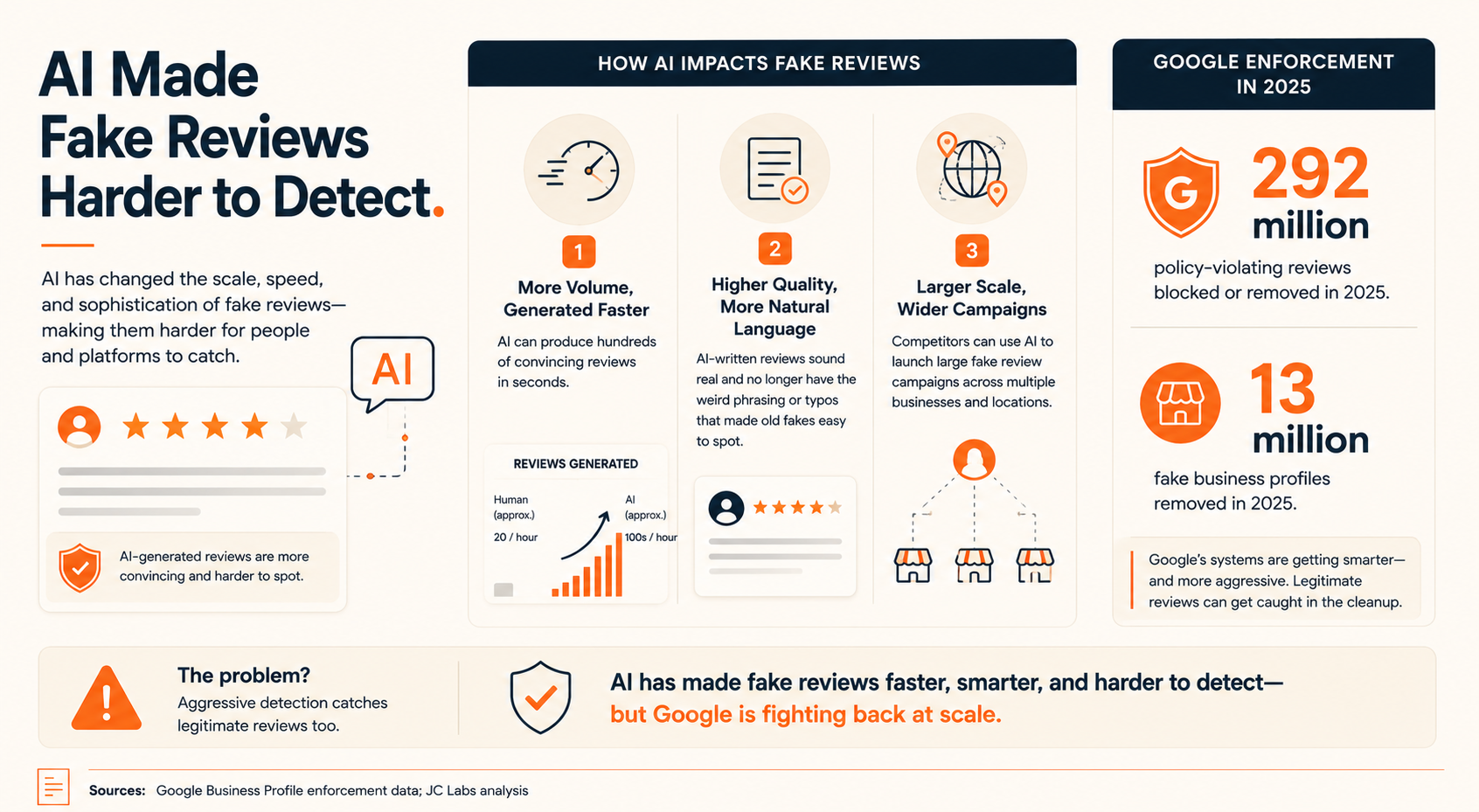
Fake reviews are not new. But AI changed the scale.
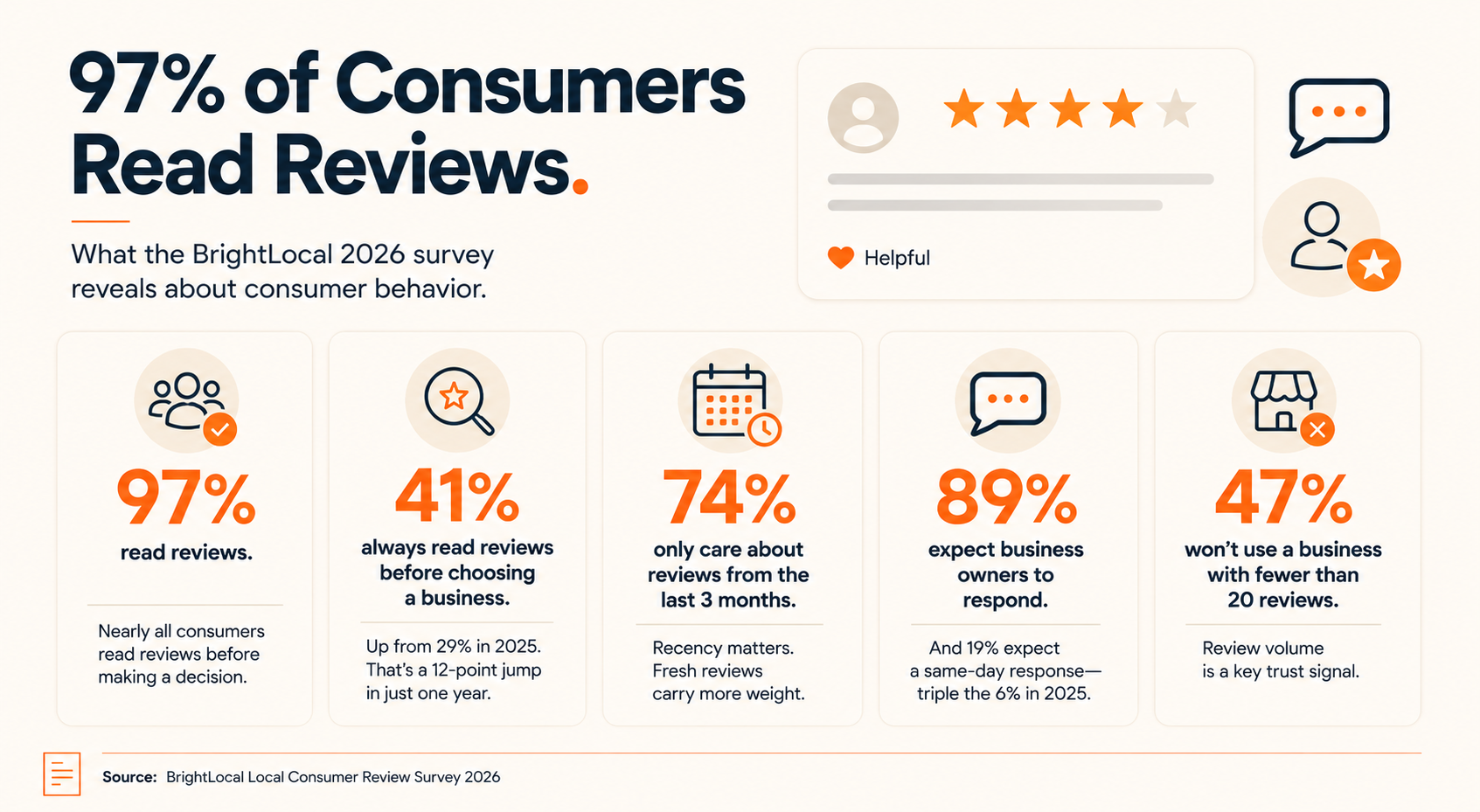
Volume. AI generates convincing reviews in seconds. A human typing fake reviews might produce 20 an hour. AI produces hundreds. The language is harder to catch because it sounds natural.
Quality. AI-written reviews do not have the spelling mistakes or weird phrasing that old fake reviews had. Detection tools have to work harder.
Review extortion. Some competitors now use AI to generate batches of negative reviews and post them across multiple profiles. They target businesses with high ratings. They know Google's detection systems sometimes punish the business instead of the fake reviewer.
Google's response is aggressive. In 2025, Google blocked or removed 292 million policy-violating reviews — 21% more than 2024. Over 13 million fake business profiles were also taken down.
The problem: aggressive detection catches legitimate reviews too. Google's July 2026 investigation into disappearing reviews is proof. Their statement said:
"When our systems detect suspicious reviews, we take a range of actions including removing reviews and temporarily pausing reviews on the profile to prevent further abuse."
Translation: your real reviews can get swept up in the cleanup.
Why Canadian SMBs Should Care
You are not under the FTC rule. But you are under Google.
Google enforces globally. The same algorithms that flag fake reviews in the US also run in Canada. Your Google Business Profile does not get a pass because you are in Vancouver or Toronto.
No appeal process. When Google decides your profile has suspicious review activity, they can pause new reviews or remove existing ones. There is no regulator to call. No ombudsman. You appeal through Google support channels, which is a black box.
Suspension risk is real. A competitor can trigger a review investigation against you. An aggressive review spike from a campaign you ran can look like fraud to Google's systems. The result is the same: your social proof disappears.
Consumer trust does not care about jurisdiction. Your Canadian customers read the same news about fake reviews. They know the FTC is cracking down in the US. If your profile looks suspicious, they will move on.
What Google's Systems Actually Look For
Google does not publish exact detection criteria. But patterns from case data and practitioner experience show what triggers flags.
- Volume spikes. A business that gets 3 reviews a month then gets 30 in a week looks suspicious. Even if the reviews are real, the pattern matches known fraud behavior.
- IP clustering. Multiple reviews from the same IP address or location. This is how bulk fake campaigns operate.
- AI-generated language. Google runs its own detection models. Reviews that follow AI patterns trigger flags.
- Geographic mismatch. A Canadian plumbing company getting reviews from people in India or the Philippines is a red flag, even if the reviews are positive.
- New account reviews. Reviews from accounts with no history, no photo, and one total review.
- Same-device reviews. Multiple reviews posted from the same device across different accounts.
If your profile trips multiple flags, Google's system can pause your entire review stream. Not remove individual reviews. Pause all of them.
Canadian Legal Landscape
Canada does not have a specific "fake reviews" rule. But that does not mean there is no legal risk.
The Competition Bureau enforces false and misleading representations under the Competition Act. Section 74.01 covers deceptive marketing. If a business is caught posting fake reviews, the Bureau can take action. Its 2025-2026 annual plan prioritizes enforcement in digital services and artificial intelligence.
British Columbia's Business Practices and Consumer Protection Act allows the government to pursue businesses that engage in deceptive practices. Other provinces have similar legislation.
Prediction: Canada will follow. When the FTC takes a major enforcement action, Canada's Competition Bureau typically monitors the outcome. Public and political pressure will build. A dedicated fake review rule for Canada is likely within the next two years.
Action Checklist for Canadian SMBs
You do not need to panic. You need a system.
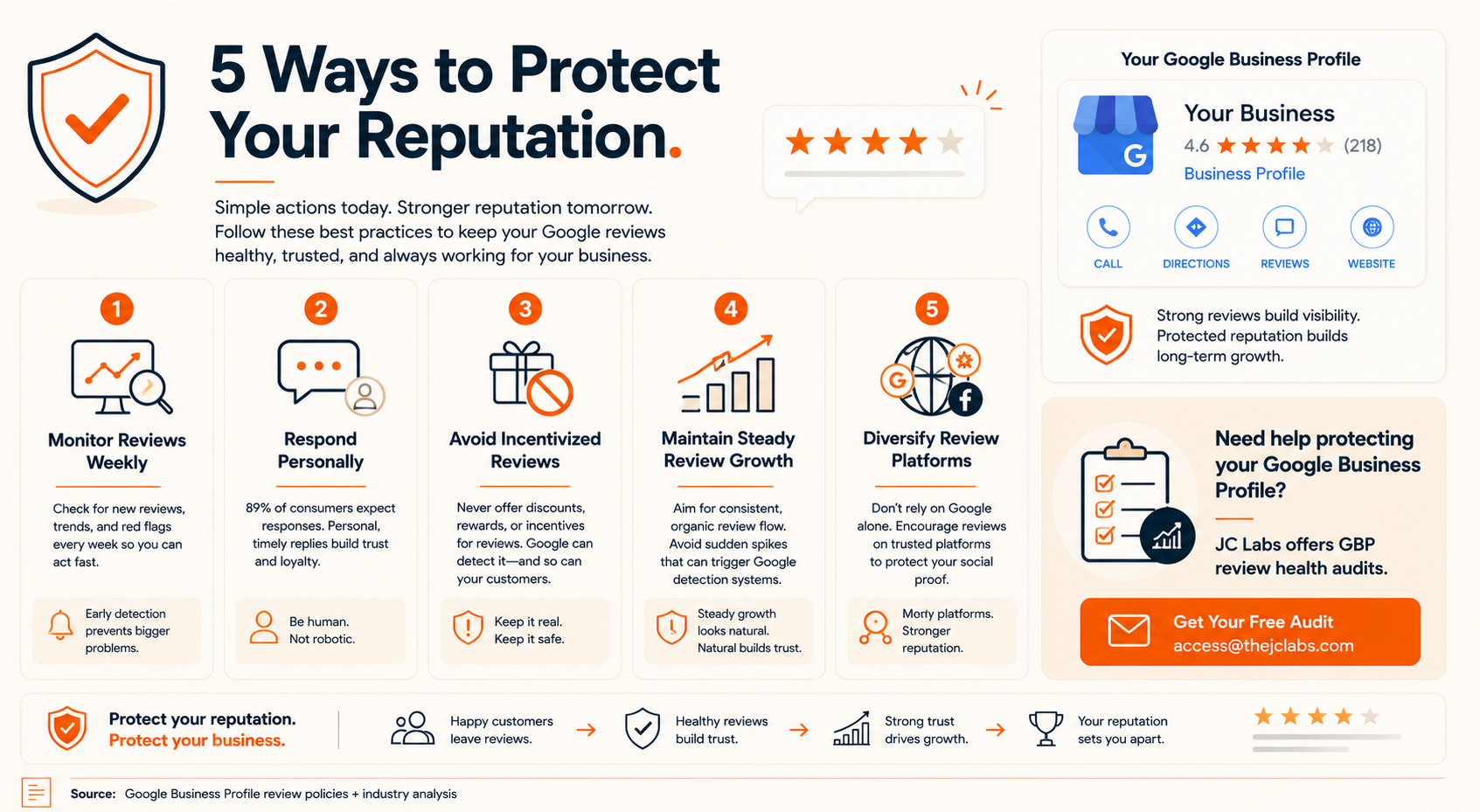
- Monitor your reviews weekly. Know what is being posted.
- Respond quickly. If fake reviews appear, flag them to Google immediately.
- Respond to every review. 89% of consumers expect it. Do not use templates. Personalize each response. Speed matters.
- Flag suspicious reviews. Use Google's "Flag as inappropriate" tool for anything fake. Keep a record of what you flagged and when.
- Never incentivize reviews. Do not trade discounts for positive reviews. Do not ask family to post reviews. Google's detection systems will find you.
- Keep a steady review flow. The BrightLocal data shows review velocity matters more than spikes. Aim for 2 to 4 per week if you are a small business. This looks organic and avoids triggering Google's volume spike detection.
- Diversify your review platforms. Relying only on Google is dangerous. As of July 2026, Google is actively investigating profiles with disappearing reviews. Encourage customers to leave reviews on trusted platforms too.
GBP Suspension Recovery: Step by Step
If Google pauses or suspends your reviews, here is the recovery path.
- Confirm the suspension. Check your Google Business Profile dashboard for any notifications about review restrictions.
- Identify the trigger. Look at your recent review activity. Did you get a spike? Did someone post suspicious reviews? Did a competitor target you?
- Remove problem content. If you identify fake reviews on your profile, flag them. Document everything.
- Submit a reinstatement request through Google Business Profile support. Be specific. Explain what happened and what you have done to fix it. Include your documentation.
- Wait. Google's review process is not fast. The July 2026 investigation has made wait times longer.
- Prevent recurrence. Steady review flow. No spikes. Fast responses. Monitor weekly.
Warning: This process is not guaranteed. Google does not owe you a reinstatement. Your best protection is never getting flagged in the first place.
The JC Labs Angle: Review Health Audits
Most Canadian businesses do not know their profile is at risk until reviews stop coming in.
We run GBP review health audits that look at:
- Review velocity and spike patterns
- Response quality and speed
- Flag and removal history
- Competitor review activity
- Geographic and IP pattern analysis
- Platform diversification gaps
The audit takes about 30 minutes. You get a report with your risk level and specific actions to fix problems before Google flags you.
We also offer ongoing review management: weekly monitoring, response drafting, flagging, and velocity management. This keeps your profile clean and your ratings stable.
Think your Google Business Profile may have review risks?
Request a free GBP health check from JC Labs. We’ll review your profile’s review activity, reputation signals, and potential risk areas, then provide recommendations to help protect your online visibility.
Request your GBP audit here:
https://www.thejclabs.com/contact/
Learn more about how JC Labs helps Canadian businesses manage reviews and improve local visibility:
https://www.thejclabs.com/